
Laboratory for Nanotechnologies and Nanosystems (NANOLAB)
- Laboratory type:
- teaching and research-expert laboratory
- Head:
- Dr. Lidija Matija, Full Professor
- Description of laboratory activities:
- characterization of materials using SPM instrumentation, FTIR and UV/Vis/NIR spectroscopy
Nanolab is a laboratory for advanced material characterization, equipped with modern instrumentation that enables research across a wide range of scientific disciplines. The laboratory focuses on the analysis of structural, optical, and chemical properties of materials, aiming to understand physical-chemical phenomena, thereby supporting interdisciplinary research and the development of innovative biomedical solutions.
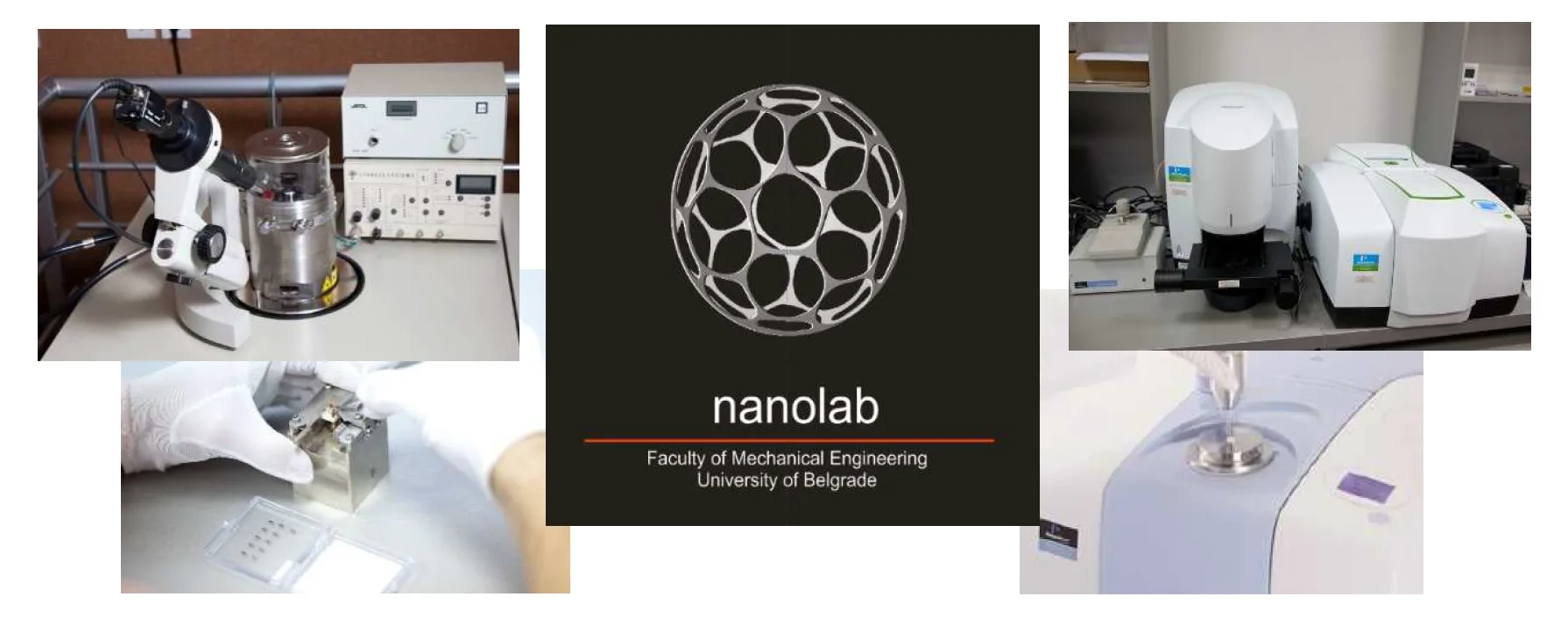
Instrumentation
Modern equipment for nanocharacterization and spectroscopic analysis of materials allows the examination of their properties at the nano and microscale, enabling researchers to study the chemical composition and interactions within materials in detail, as well as the potential to discover physical and surface properties at the atomic level.
| Model | Instrument | Range / technique | Manufacturer |
|---|---|---|---|
| JSPM 5200 | Scanning Probe Microscope | STM · AFM · MFM | JEOL |
| Lambda 950 | UV/Vis/NIR Spectrophotometer | 175-3300nm | Perkin Elmer |
| Spotlight 400 | FTIR Microspectroscopy System | 7800-600 cm−1 | Perkin Elmer |
| JFC-1300 | Auto Fine Coater | sample preparation for SEM · STM · AFM · MFM | JEOL |
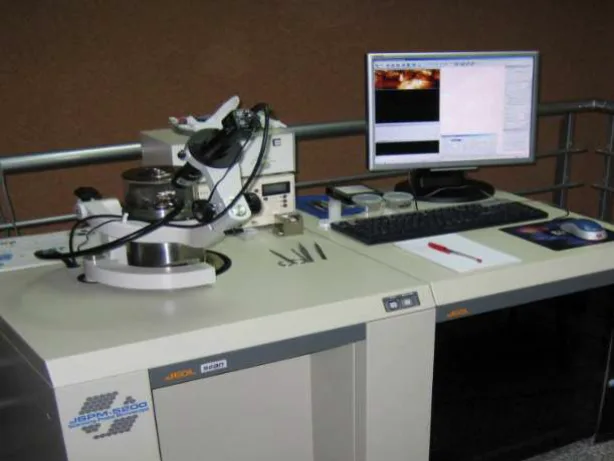
JSPM 5200, Scanning Probe Microscope
, manufacturer: JEOL
JSPM 5200 is a high-resolution scanning probe microscope that can be configured to characterize the examined sample using one of three main SPM techniques: STM, AFM, and MFM. This sophisticated device enables three-dimensional characterization of surface structures at the nanometer level, providing a detailed insight into the topographical, mechanical, and chemical properties of materials at the atomic scale.
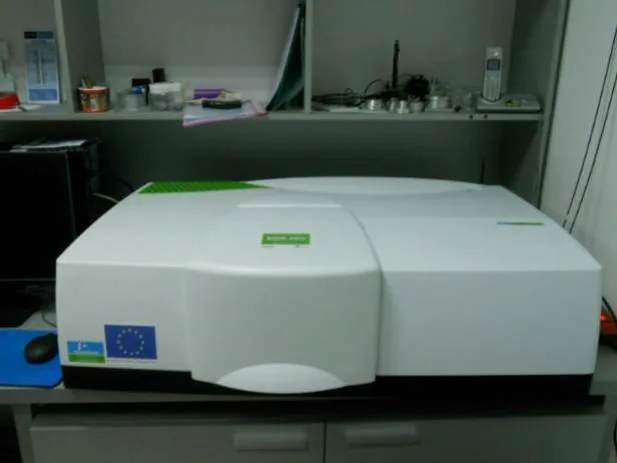
Lambda 950, UV/Vis/NIR Spectrophotometer
, manufacturer: Perkin Elmer
The Lambda 950 is a dual-beam spectrophotometer that operates in the ultraviolet (UV), visible (VIS), and near-infrared (NIR) spectral range (175-3300nm). Equipped with deuterium and tungsten-halogen radiation sources, it is intended for spectroscopic characterization of materials in solid and liquid states. UV-Vis-NIR spectroscopy is crucial for investigating the optical properties of materials, particularly in the context of developing new optoelectronic devices.
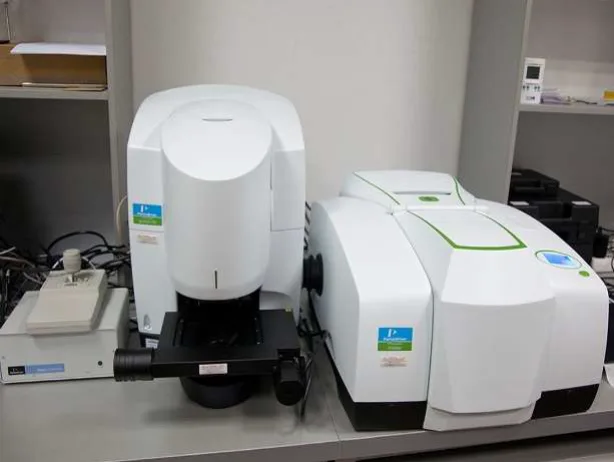
FTIR Microspectroscopy System (Spotlight 400 FT-IR Imaging System)
, manufacturer: Perkin Elmer
The FTIR spectroscopic system is a sophisticated system that combines microscopy and spectroscopy to connect the microscopic image of the examined sample with its spectral characteristics. FTIR spectroscopy enables the identification of functional groups and structural elements in organic and inorganic compounds, making it an important tool in chemistry, pharmacy, and materials engineering. The system characterizes samples in the near to far-infrared radiation region (7800-600 cm−1), and it is possible to characterize samples in various aggregate states.
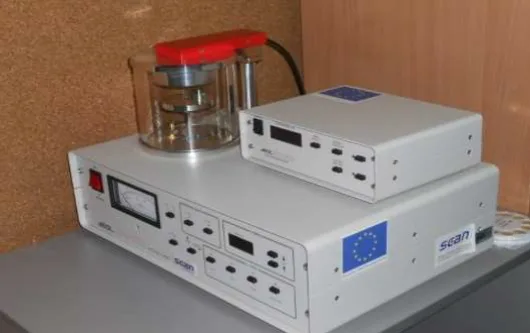
JEOL JFC-1300 Auto Fine Coater
, manufacturer: JEOL
The JFC-1300 is a device used for sample preparation, for SEM, STM, AFM, MFM, by applying thin metal coatings to the sample material.
Research within the Nanolab laboratory of the Department of Biomedical Engineering aims to enhance understanding of materials and nanomaterials, as well as their potential applications in medicine and biomedical engineering, contributing to the development of new therapeutic and diagnostic tools and devices.