
Prof. Dr. Đuro Koruga
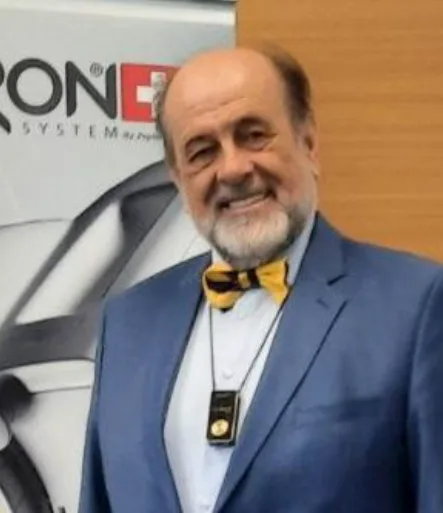
Dr. Đuro Koruga is the founder of the Biomedical Engineering Module, which later evolved into a Department, and he was the first professor to establish the undergraduate, master, and doctoral study programs.
Prof. Dr. Đuro Koruga graduated (1973) and obtained his master's degree (1976) from the Faculty of Mechanical Engineering, University of Belgrade. He collaborated intensively with researchers from the Faculty of Medicine and the Biological Institute, and defended his doctoral dissertation on the structural-energetic-informational bases of microtubules and their significance for the acupuncture mechanism in 1983, before a joint committee of the Faculty of Medicine and the Faculty of Mechanical Engineering, University of Belgrade.
For the academic year 1984/1985, he received the Fulbright and IREX one-year scholarships for further education in the USA in the field of biotechnology. As part of that program, he spent three months at Boston University and nine months at the University of Arizona (Tucson). He conducted research in the field of microtubules and molecular electronics for medical purposes within the Faculty of Medicine at the University of Arizona in the Biotechnology Laboratory.
Upon his return in late 1985, he founded the Center for Molecular Machines at the Faculty of Mechanical Engineering in Belgrade. In 1988, he was appointed as an assistant professor in the field of bio-automation at the Department of Automatic Control. In the same year, he was invited to be a visiting lecturer at Chuo University in Japan.
During his six-month stay in Japan, he expanded his collaboration with the RIKEN Institute, Tsukuba Science City, the University of Tokyo, and others. Upon his return from Japan, he focused on equipping the Center for Molecular Machines at the Faculty of Mechanical Engineering in Belgrade, which, with the acquisition of STM/AFM devices in 1990, evolved into a nanolaboratory.
In the middle of 1991, he received an invitation from the University of Arizona to be a visiting professor for the academic year 1991/1992. While at the University of Arizona, he became involved in the field of nanotechnology and its applications in medicine.
He began experimental research with the C60 molecule and, upon returning, brought the first microgram quantities of this molecule to Serbia. In the nanolaboratory at the Faculty of Mechanical Engineering in Belgrade, together with his research team, he obtained the first STM images of the C60 molecule with atomic resolution in 1992.
He published his research results in international journals, and upon the invitation of the Elsevier publishing house, along with four other American scientists, published the first book on the C60 molecule. He was appointed as an associate professor at the University of Arizona in 1993 and at the University of Belgrade in 1994, and became a full professor in 1998.
He retired in 2014 but continued to engage in research and the educational processes of talented young students (Center for Excellence for Students).
He mentored 32 doctoral dissertations, published 68 papers in international journals with an impact factor, and over 150 scientific and technical papers. He is the author of three monographs and co-author of six others. He has been cited 652 times, including citations by Nobel laureate Roger Penrose in the fields of microtubules and nanotechnology (C60 molecule).
He holds nine approved international PCT/US/EU/Japan patents. For his innovative activities, he has received numerous awards at international innovation exhibitions in China and Russia, and was awarded a gold medal by the European Federation for Innovation based in Switzerland. He is also a recipient of the WIPO (World Intellectual Property Organization) award for the best patent in 2018 (US2017035348 (A1)).